- Prep
- 20 min
- Cook
- 30 min
- Total time
- 50 min
- Yield
- 4 servings
- Difficulty
- EASY
- Calories
- 430 kcal
Quick summary
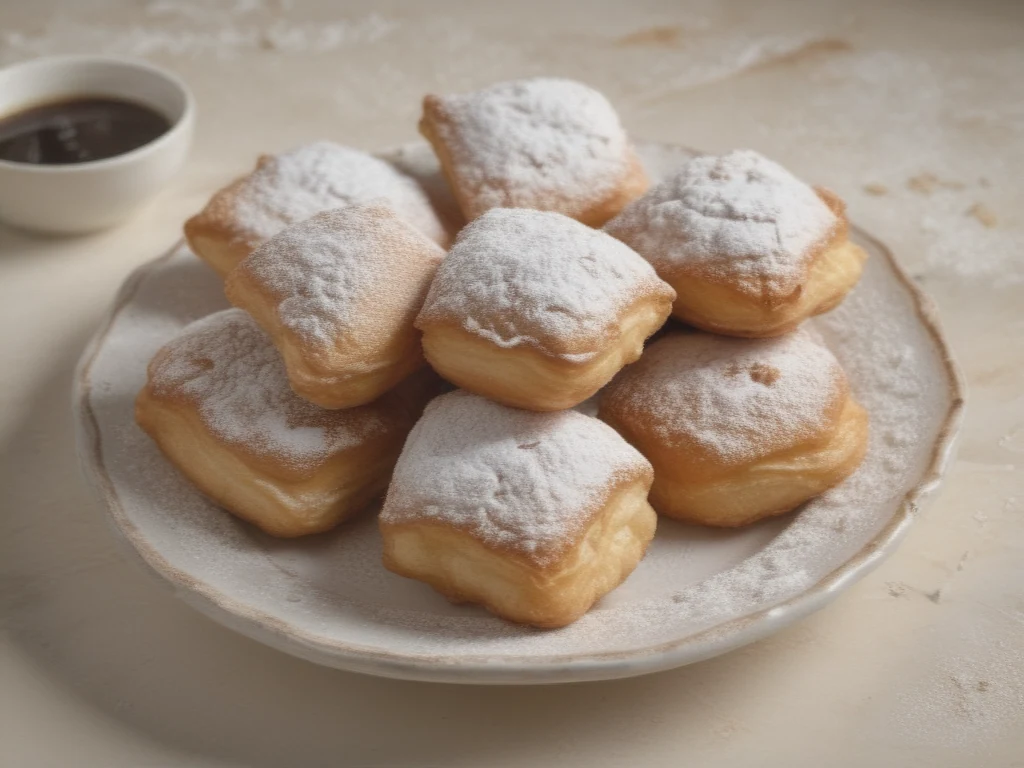
“Soft and airy leavened dough pillows, deep-fried in heated oil until golden brown and generously sprinkled with powdered sugar, traditional from France and Louisiana.”
What you need to know
- The one-hour biological fermentation develops the gluten network responsible for the large internal air pockets.
- The characteristic square cut eliminates dough scraps and ensures uniform expansion without hardened edges.
- Thermal control of the oil at one hundred and eighty degrees allows internal cooking without excessive fat absorption.
Ingredients
Main
- 2 cups all-purpose flour
- 1/2 cup of warm water
- 2 tablespoons of sugar
- 1 egg
- 1 tablespoon of dry active yeast
- 1 tablespoon of melted butter
- Oil for frying
- Powdered sugar for dusting
- Ensure the oil is very hot so the beignets do not absorb too much oil.
- For the best texture, use a medium temperature when frying.
- Enhance the dough with spices like cinnamon or nutmeg.
- You can add a filling of jam or chocolate cream before closing the beignet.
- For a less sweet version, omit the powdered sugar.
Instructions
Principal
- In a bowl, mix the flour, sugar, and baking powder. Set aside.
- In another bowl, beat the egg and add the warm water and butter. Mix well.
- Add the liquid mixture to the dry ingredients, mixing until a homogeneous dough is obtained.
- Knead the dough for about 5 minutes until smooth.
- Let the dough rest in a warm place for approximately 1 hour or until it doubles in size.
- After resting, roll out the dough on a floured surface, leaving it about 1 cm thick.
- Cut into squares of about 5 cm.
- Heat the oil in a deep pan to 180°C and fry the beignets until golden.
- Remove from the pan and place on paper towels to eliminate excess oil.
- Sprinkle with powdered sugar before serving.
Chef's tips
- Check the temperature of the warm water so as not to exceed forty degrees and inactivate the dry biological yeast.
- Drizzle the beignets with hot oil using a slotted spoon to stimulate rapid puffing during frying.
- Sprinkle the powdered sugar with a fine sieve while the sweets are still hot for ideal adhesion.
Variations
- Add fine lemon or orange zest to the dough during kneading to add fresh citrus aroma.
- Inject warm dulce de leche or artisanal berry jam into the puffed interior using a fine pastry tip.
- Add a generous pinch of grated nutmeg and vanilla extract to the dough liquids for a rustic perfume.
Substitutions
- Warm water can be replaced with warm whole milk or evaporated milk for an even softer crumb.
- The melted butter can be replaced with refined lard or sunflower oil in the same proportion indicated.
- Traditional powdered sugar can be mixed with ground cinnamon or replaced by fine confectioners' sugar.
How to store
Store in a paper bag or closed container at room temperature for up to two days. Like any fried dough, immediate consumption is ideal; when reheating, place for three minutes in a hot oven to recover freshness.
Can it be frozen?
Freeze the already cut and raw dough squares on a floured baking sheet for two hours, storing in sealed bags for up to sixty days. Fry directly from frozen, adjusting heat to cook interior through.
What to serve with
Serve accompanied by classic café au lait served in a wide cup, dense creamy hot chocolate with cinnamon, homemade apricot jam, or a portion of fresh red berries to balance the sugar of the frying.
Frequently asked questions
Can I store the raw dough in the refrigerator?
Yes, let the dough ferment slowly in the refrigerator overnight before opening, cutting, and frying the sweets.
Can I bake the beignets in the oven?
They can be baked at two hundred degrees for fifteen minutes, but they will result in sweet buns instead of the typical fried texture.
Why did the beignets turn out raw inside?
The oil was at a temperature above one hundred and eighty degrees, burning the outer shell before cooking the center.
How to get the hollow pillow-like effect?
The dough must rest until it doubles in volume and the oil needs to be hot enough to generate immediate steam.